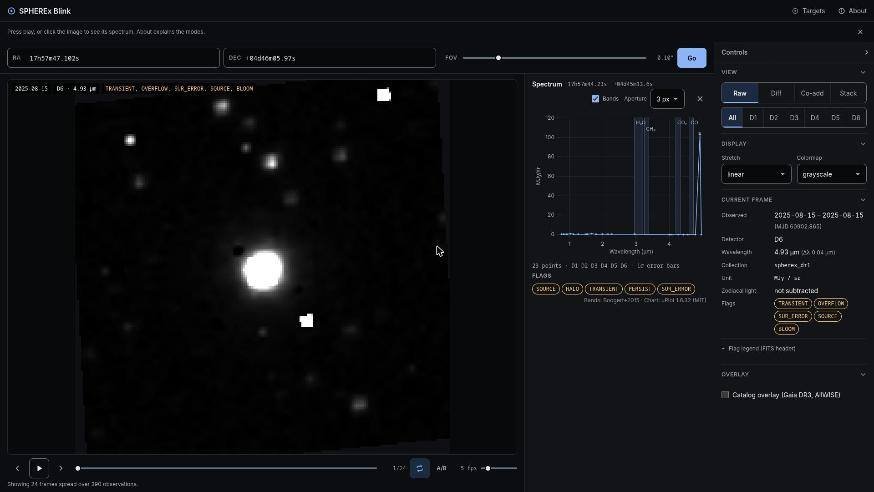
SPHEREx Blink showing Barnard's Star with the spectrum panel open
SPHEREx Blink
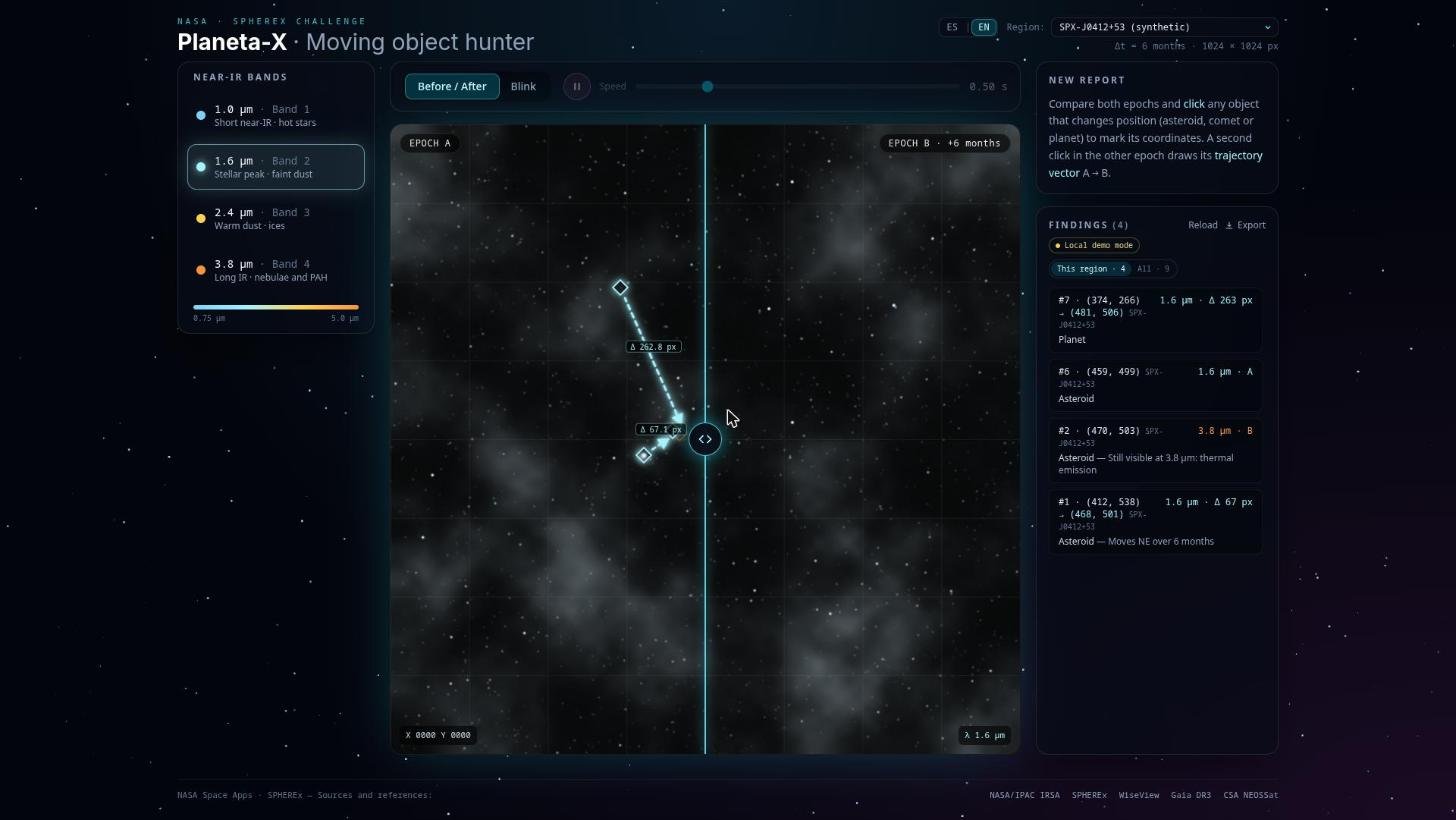
Planeta-X comparing two epochs with a movement vector
Planeta-X

NASA Space Apps Challenge 2026 · Planet X and SPHEREx

Two tools, one sky

SPHEREx Blink and Planeta-X: two ways to spot moving objects in SPHEREx-era infrared images.


Team AirmanPrep · AirmanPrep.com
Luis000923 · charlie-002-XD · cruncron-png

The problem

The sky is public. The tools aren't.

SPHEREx maps the entire sky in 102 infrared colours, but every image sits in a multi-extension FITS file behind an archive interface.

Checking whether something moved means comparing dates by hand. That is how Pluto was found, and it is still a job for experts.

102

infrared bands per image, six detector arrays, two full-sky passes a year.


The challenge: a public web tool that shows a patch of sky as a short film, so anyone can spot what moves.

One problem, two angles

Why two projects for one problem?

One starts from the data, the other from the person using it. We built both and kept them side by side so you can compare them.
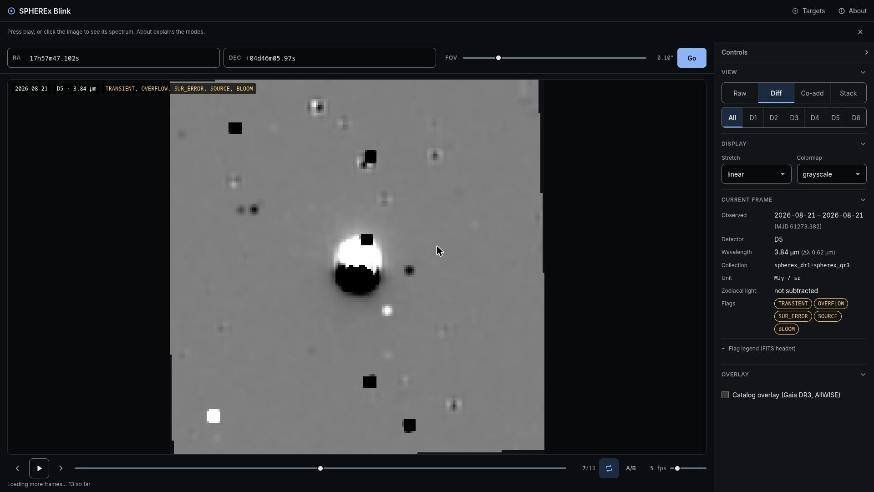
SPHEREx Blink difference view of Barnard's Star
SPHEREx Blink · Luis. Starts from the data. Real SPHEREx exposures fetched live for any RA/Dec. Built to measure motion.
Planeta-X epoch comparator with a movement vector
Planeta-X · Charlie. Starts from the user. Compare two epochs, click what moved, export the report. Built to learn and report.

SPHEREx Blink

Real data, real motion.

Enter RA/Dec and every SPHEREx exposure of that patch plays as a time-lapse. In difference mode Barnard's Star leaves a bright and a dark half.

We measured about 9 arcsec per year north; the catalogue says 10.4, our uncertainty is about 2.

WISE 0855 is too faint for single frames and Epsilon Indi B is an unresolved binary, so the app claims no detection for either.
Difference image of Barnard's Star with a bright and dark pair
Difference mode, north up, east left.
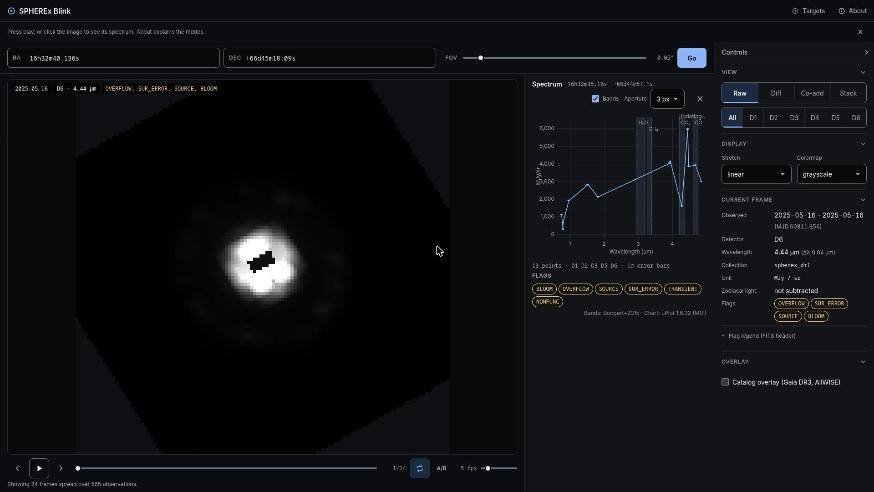
R Draconis with spectrum panel and flag badges
R Draconis: the saturated core is flagged, not hidden.

SPHEREx Blink · the data

Spectra, flags and live NASA data.

Click a pixel for its spectrum. Flags come from the FITS headers. Epochs come from IRSA, cutouts from the open SPHEREx copy on AWS.

280–565
observations per target
24
frames across detectors D1–D6
0.3–0.7 s
to first frame, shipped cache
Planeta-X comparing Epoch A and Epoch B with a trajectory vector and a findings list
Planeta-X: slide between epochs, mark the mover, read the findings list.

Planeta-X

Compare epochs, mark what moved.

Slide or blink between Epoch A and Epoch B across four near-infrared bands. Click an object that shifted and the app draws its A to B vector.

  • Findings list with export to CSV or JSON.
  • Interface in Spanish and English; PHP backend.

Its images are WISE cutouts from IRSA and simulated SPHEREx-style regions, not live SPHEREx exposures.

Use them

Open both and compare.

Same challenge, two answers. One reads the real archive, the other teaches and records the hunt.

SPHEREx Blink is open source under Apache-2.0; every view is a link you can share or embed.